Does your home's temperature affect your mood?


Adam Knight - Lead Engineer
The science behind warmth and wellbeing - and why the temperature of your house may secretly be influencing your mood. Experts reveal how your home temperature shapes your winter happiness.
It turns out the secret to beating Blue Monday - the bleakest day of the year - could be far more basic than a holiday, pay rise or a fitness overhaul.
It could start with your thermostat.
A new national survey of 2,000 UK adults has uncovered the exact temperature at which the nation’s mood and productivity spikes - a moment researchers are calling Britain’s “ideal ThermoState”, when comfort chemistry kicks in, stress levels fall, and concentration rises.
According to heating and cooling experts BOXT’s new Warmth and Wellbeing study, the national mood peaks at exactly 21°C, the point at which Brits feel calmer, happier, better rested and more energised.
Britons reach an emotional low point when indoor temperatures dip to 17°C, while productivity and motivation is most improved once the thermostat hits 19°C.
In fact, over two in five (44%) Brits claim they feel instantly “happier” when their home hits 'ideal' and most comfortable temperature, while almost a third (32%) say they feel more productive.
The study, commissioned by BOXT, revealed a clear tipping point.
Many of us are only one dial-turn away from feeling worse – and then from tipping into ‘over-warmth’, where pushing the thermostat higher than 22°C, makes mood and alertness begin to dip again.
Dr Sophie Mort, a leading clinical psychologist and British Mental Health Expert at Headspace, refers to this “Mood-Heat Curve” as a shallow inverted U-shape that reveals how the body responds to cold, comfort and overheating.
She said, “There is a very real physiological response to temperature. Being too hot or too cold can quietly undermine our state of mind in ways we often underestimate. Our emotional and cognitive responses tend to follow a Mood-Heat Curve, where the body and brain respond differently at colder, optimal and overly warm temperatures, and even small shifts in warmth can start to influence how calm, focused or tense we feel.”
BOXT’s research found that Brits experience noticeable mood swings based on how warm their home or workplace feels.
When asked how temperature affects their state of mind, over a quarter (27%) admit they “can’t relax” when the house feels chilly, while over a fifth [22]% say they become down and irritable.
The average adult says their concentration significantly drops when their home is 17°C, while 22°C is the point where they become more ‘tense’ and ‘argumentative’ when rooms get too warm.
The findings follow years of soaring energy prices, which have pushed up heating costs for the average home and led millions (25%) to dial down — or completely switch off (14%) — their heating despite feeling cold.
Reflecting on the impact of colder environments, Dr Mort adds:
“When indoor temperatures fall too low, the body naturally shifts into heat-conserving mode. This can increase stress hormones, subtly reduce cognitive performance and make emotional regulation and sustained concentration more difficult, which is why many people in colder environments describe feeling more tense, distracted or irritable.”
According to the survey, one in eight (12%) couples/households argue about heating at least once a week, while a similar amount (13%) secretly adjust the thermostat when their partner isn’t looking.
Brits are also locked in daily battles over thermostats at work, with 10% experiencing “temperature tension” with colleagues, while one in nine (11%) say heated office emails get exchanged.
BOXT, together with Dr Mort, have developed a Mood Thermostat Scale based on the survey data to show how emotional wellbeing changes as indoor temperature rises:

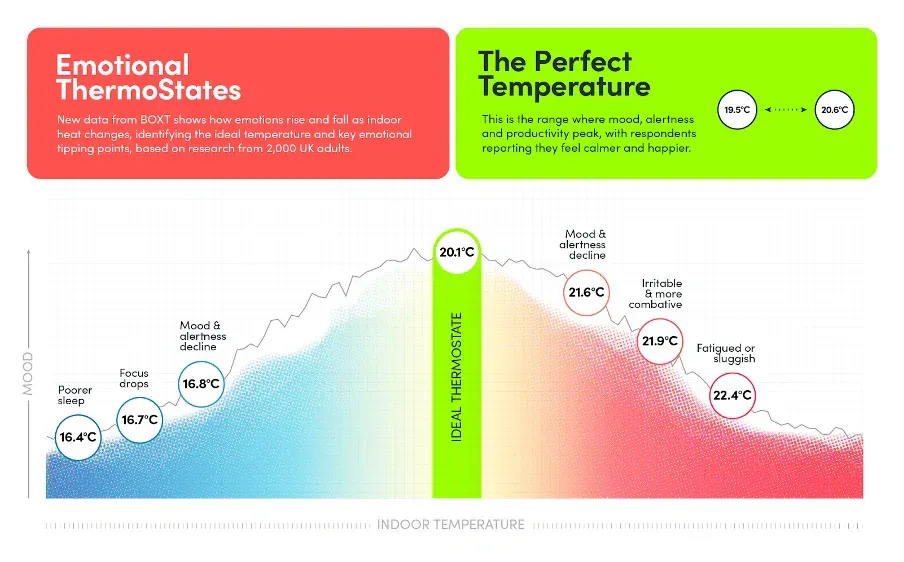
Britain’s ‘Mood Thermostat’ scale
Dr Mort, who analysed BOXT’s data, says our response to temperature follows an inverted-U shaped biological curve:
1. Cold Zone (anything 17°C or below): Stress Mode
Respondents were more likely to report:
- Mood and Alertness decline - 17°C
- More tense and argumentative - 17°C
- Concentration drops - 17°C
- Poorer sleep - 16°C
- Feel sad or low - 17°C
Dr Mort, says that as temperatures move into a comfortable mid-range, people often experience a lift in mood, motivation and productivity. It can feel a little like emotional central heating, where the brain and body begin working more efficiently together.
“But once we push beyond this ThermoState zone into overheating, reaction time and mental sharpness begin to decline, and fatigue or restlessness can set in.”
A 2021 study, which exposed young adults to cooler environments (ranging from 10 - 22 °C) - saw their cognitive performance decline. Stress markers like heart rate, sweating and breathing changes spiked when the temperature strayed from a comfortable “neutral” zone.
2. ThermoState Zone ( 19-21°C): “Comfort Chemistry” - our winter wellbeing sweet spot.
This is the peak of the inverted-U curve, the temperature range where people said they felt calmer, happier and more productive, when their home reaches their 'ideal' and most comfortable temperature. Respondents reported:
- I feel happier 44%
- I sleep better 42%
- I feel calmer or more relaxed 40%
- I feel more productive 32%
- I feel more energised 28%
- My motivation improves 25%
- I feel less irritable 25%
- I feel more sociable or positive 24%
- My stress levels drop 24%
“The ThermoState is like emotional central heating, the point where the brain and body work in sync,” says Dr Mort.
3. Over-Warm Zone (22°C or above): Energy Drain
28% of Brits say overheating makes them “drowsy”. Brits in this category were more likely to report:
- Mood and alertness decline 22°C
- Concentration significantly drops 22°C
- Irritable and more argumentative 22°C
- Inability to relax 22°C
- Fatigue or sluggishness 22°C
- Broken sleep 22°C
- Lower mental sharpness 22°C
Dr Mort says the pattern echoes lab findings showing that overly warm environments can impair reaction time and drain cognitive energy.
Previous studies have found that elevated indoor temperatures (above ~24 °C) tend to impair cognitive performance, particularly processing speed and reaction time. While complex reasoning tasks are slightly more resilient, there is still a general decline in mental performance when temperature is too high.
Britain’s ‘Mood Heat Map’
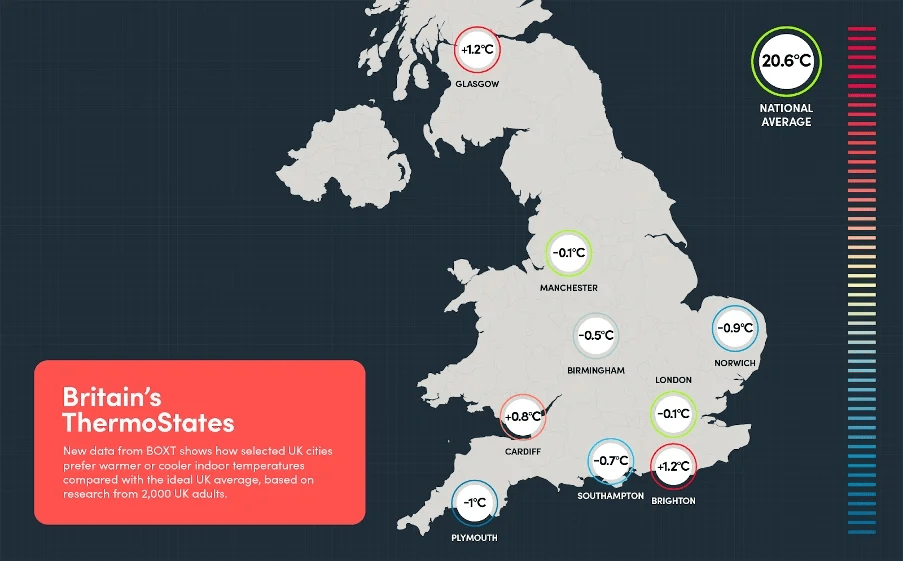
BOXT’s study revealed which regions are most affected by cold homes and offices and which get the biggest emotional lift from warming up.
The map shows:
- Coldest moods: LEEDS, where 34% report feeling “down and irritable” when their home feels too cold
- Energised when warm: BRISTOL, where 27% say turning the heating on improves motivation
- Most sleep deprived: BIRMINGHAM, where 31% say their sleep suffers when the temperatures drop too low in the house
- Most temperature arguments at home: SHEFFIELD, with 26% admitting to weekly thermostat rows
- Most hot-headed office workers - BELFAST, with 16% reporting regular battles at work over how hot or cold it is
Reflecting on why temperature matters so much to mood and wellbeing, Dr Mort concludes:
“Temperature regulation isn’t just about physical comfort, it is closely tied to psychological wellbeing, influencing memory, emotional processing, stress response and how relaxed or tense we feel in our everyday environments. Even relatively small shifts in indoor warmth can affect mood, energy, sleep quality and motivation, particularly during winter when emotional resilience is already under pressure.”
“The findings show just how closely our winter wellbeing is tied to the spaces we live in,” adds Adam Knight, BOXT’s Lead Engineer. “Blue Monday affects many of us, but getting the temperature right can lift energy levels, improve sleep and make everyday life feel easier.”
“People are understandably cautious about putting the heating on right now, but a well-serviced boiler can actually save money by running more efficiently, so you’re not overpaying for wasted heat.
“When a system isn’t working properly, it forces your home below its comfort zone, and you end up feeling tense, tired or low without realising why. Even small tweaks to the heating setup can make a big difference to both how you feel and what you spend.”
Survey methodology:
The research was conducted by Censuswide with 2,000 general consumers (18+) between 11.12.25-15.12.2025. Censuswide abide by and employ members of the Market Research Society which is based on the ESOMAR principles and are members of The British Polling Council.
Adam Knight
Lead Engineer
Adam is a Technical Installation Manager with over 18 years of experience in the gas installation industry. He expertly manages all Review, Audit, and Electrical teams for our boiler and air conditioning installations, ensuring products are carefully installed in line with manufacturer specifications.
Read profile

